
News
Conquering High-Precision Manufacturing: Cold Saw vs Band Saw Applications in Automotive and Aerospa
08 Jun February 2026 | LionNord Industry
In the demanding workshops of the Aerospace Industry and Automotive Industry, "good enough" does not exist. A tolerance deviation of even 0.1mm, or a microscopic crack on the cut face, can scrap an entire batch of precision components. When facing stringent machining standards, appropriately configuring the metal cutting machine on the production line becomes a mandatory test for manufacturing engineers.
Today, technical experts at LionNord Industry dive deep into the practical performance of cold saws versus band saws in high-end manufacturing.
Industry Application Analysis
Equipment performs vastly differently depending on whether it is deployed in Aluminum Processing or a Tube Processing Plant.
Aerospace Aluminum Cutting: Aerospace-grade aluminum alloys (like the 7075 series) require extremely high cut-face quality with absolutely zero heat-affected zones. In this scenario, a high precision aluminum cutting machine (typically featuring a high-speed circular saw design) is irreplaceable. It completes the cut in a fraction of a second, yielding a surface finish ready for immediate CNC machining.
Stainless Steel Exhaust Processing: Many auto parts manufacturers struggle with how to cut stainless steel tube. Because stainless steel is highly viscous and prone to work hardening, a traditional pipe cutting machine will easily chip its teeth if the RPM or feed rate is poorly controlled. A cold saw machine paired with specialized coated blades demonstrates absolute dominance here.
Expert Opinions
Our senior application engineer notes: "For tube processing facilities, the trend is definitive. If you are still using manual or semi-automatic equipment for single-piece cutting, you are wasting production capacity. The modern standard requires directly implementing an automatic pipe cutting line that integrates automatic loading, precision cold sawing, air-blowing, and unloading into one sequence. While a band saw can technically cut tubes, its true strength lies in processing large-diameter, thick-walled pipes, not the high-tempo production of small-to-medium diameters."
Real-World Case Study
A renowned tier-one supplier in the Automotive Industry previously used an older band saw to cut automotive steering shaft blanks.
Pain Point: Unstable end-face perpendicularity caused severe tool wear in subsequent CNC lathe operations; the factory had to assign dedicated personnel daily just for chamfering.
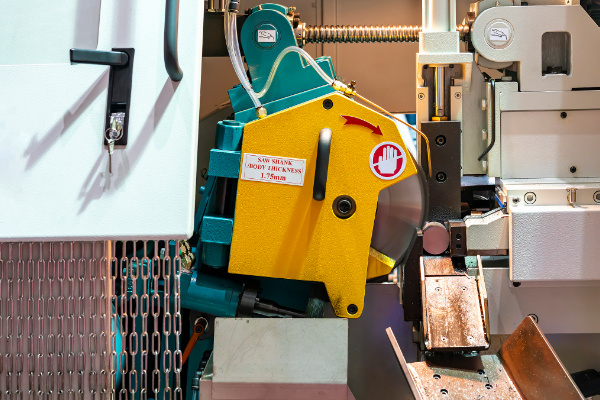
Solution: LionNord engineered and introduced a new, heavy-duty circular saw machine.
Result: The single-cut time dropped dramatically from 45 seconds to just 8 seconds. Perpendicularity was strictly controlled within 0.05mm, completely eliminating the secondary chamfering process and boosting the overall yield rate by 12%.
Troubleshooting Guide
Whether operating an automatic band saw machine or a precision cold saw, field engineers will inevitably encounter technical hurdles:
Frequent Band Saw Blade Breakage or Stripped Teeth
Diagnostic Steps: First, verify if the blade tension meets operational requirements. Next, check the hydraulic feed rate—if the initial penetration into the material is too fast, the teeth will strip immediately. As a seasoned industrial band saw machine supplier, we advise always using variable-pitch blades when cutting irregular structural profiles.
Severe Galling or Burrs on Cold Saw Cut Faces
Diagnostic Steps: This symptom typically indicates that the blade on the aluminum cutting machine has dulled, or the Minimum Quantity Lubrication (MQL) system is spraying unevenly or clogging. Operators must stop the machine immediately to inspect the cutting oil nozzle alignment.
Q1: Can I choose a cold saw for cutting large blocks of mold steel?
A: This is not recommended. For solid blocks exceeding 200mm in diameter, a metal band saw machine remains the optimal choice. Cold saw blades are limited by their diameter size and face severe chip-evacuation difficulties during extreme cross-section cuts.
Q2: How do I prevent thin-walled stainless steel tubes from getting crushed during the clamping phase?
A: This is a frequent challenge in pipe cutting machine applications. The solution is to replace standard V-jaws with custom profile jaws (soft jaws) and appropriately lower the hydraulic clamping pressure. This ensures the material is gripped firmly without collapsing the tube wall.
 English
 chinese
