
News
Optimal Blade Pitch (TPI) for Cutting Solid Die Steel Bars: Field Test Results
29 Jun February 2026 | Lionnord Industry
Cutting solid die steel destroys band saw blades if your setup is wrong. Die steels like D2 and H13 are notoriously tough, highly abrasive, and prone to work hardening. If you choose the wrong blade pitch, you will experience stripped teeth, crooked cuts, or a stalled machine.
To give operators concrete data, we ran a series of field tests here at LionNorda. We wanted to move past theoretical charts and determine the exact optimal Teeth Per Inch (TPI) for cutting solid die steel bars on a standard industrial band saw.
Here is what the data actually says.
The Bottom Line Up Front (BLUF)
For cutting solid die steel bars between 4 inches (100mm) and 8 inches (200mm) in diameter, a 2/3 variable pitch bi-metal or carbide-tipped band saw blade yields the best combination of cutting speed and tool life.
Field Test Methodology
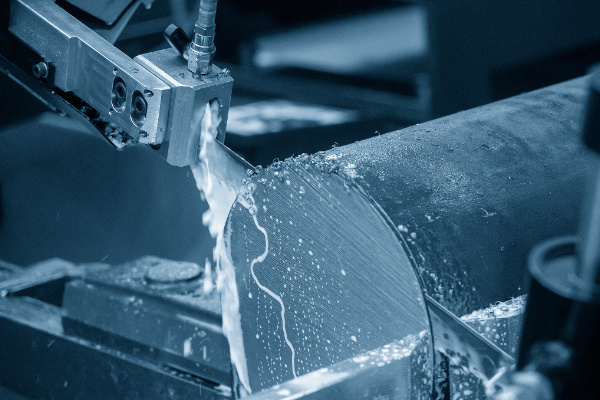
We set up a dual-column heavy-duty band saw to cut continuous slugs from a solid round bar of D2 Tool Steel.
Test Parameters:
Material: D2 Solid Tool Steel Bar (Hardness: ~20-25 HRC annealed state)
Diameter: 6 inches (152mm)
Machine: Twin-pillar automatic band saw
Blade Type: M42 Bi-Metal (1.25" x 0.042")
Coolant: High-lubricity synthetic flood coolant (10% concentration)
Goal: Measure cut time, chip formation, and blade wear over 50 continuous cuts.
The Results: Testing Different TPI Configurations
We tested three common variable pitch blades. Variable pitch (having alternating tooth sizes) is standard for this material because it breaks up harmonic vibrations.
1. The 4/6 TPI Blade (Too Fine)
Operators often default to a 4/6 TPI blade for general steel cutting. On the 6-inch D2 bar, this failed quickly.
Performance: The cut started quietly but slowed down within minutes.
The Problem: The gullets (the space between the teeth) were too small. D2 chips are thick and stringy. Because the gullets couldn't clear the chips fast enough, the blade packed up. This caused friction, massive heat buildup, and eventually stripped several teeth off the band saw blade.
2. The 1.4/2.0 TPI Blade (Too Coarse)
Next, we went highly aggressive to see if a massive gullet would solve the chip clearance issue.
Performance: The blade cleared chips perfectly, but the machine vibrated violently.
The Problem: The rule of thumb for band sawing is that you need at least 3 teeth in the cut at all times. On a 6-inch round bar, a 1.4/2.0 blade barely met this requirement at the top and bottom of the curve. The aggressive pitch caused micro-chipping on the blade teeth due to excessive shock loading.
3. The 2/3 TPI Blade (The Sweet Spot)
This configuration balanced chip clearance with tooth engagement.
Performance: Smooth cutting, consistent chip curling, and manageable noise levels.
The Result: The 2/3 TPI blade easily hit the 50-cut mark with minimal signs of wear on the tooth tips. The chips produced were tightly coiled and silver-to-light-straw in color, indicating the heat was leaving with the chip, not staying in the blade or the workpiece.
Quick Reference: TPI Selection Chart for Die Steel
Based on the field tests, LionNorda recommends the following TPI configurations based on the diameter of your solid die steel stock. Use this as your baseline setup.
Solid Bar Diameter (Inches) | Solid Bar Diameter (mm) | Recommended Variable TPI |
Up to 2" | Up to 50mm | 4/6 TPI |
2" to 4" | 50mm to 100mm | 3/4 TPI |
4" to 8" | 100mm to 200mm | 2/3 TPI |
8" to 15" | 200mm to 380mm | 1.4/2.0 TPI |
Over 15" | Over 380mm | 1.0/1.5 TPI or coarser |
Three Rules for Cutting Die Steel on a Band Saw
Getting the TPI right is only step one. To maximize the life of your band saw blades when cutting materials like D2 or H13, watch these three variables:
1. Break In Your Blade Properly
Never run a new blade at full feed rate. Run the band saw at normal surface speed (SFPM) but drop your feed pressure by 50% for the first 20 minutes of cutting. This naturally hones the ultra-sharp tooth tips so they don't fracture under the extreme pressure of die steel.
2. Read the Chips
Your chips tell you exactly how the band saw is performing.
Blue chips: You are generating too much heat (slow down band speed or increase coolant).
Dust/Powder: You are rubbing, not cutting (increase feed pressure).
Thick, coiled silver chips: Perfect.
3. Maintain High Coolant Ratios
Die steel generates extreme heat at the shear zone. Do not skimp on coolant. Run a rich mixture (9% to 12% concentration) to ensure maximum lubricity. This prevents chips from welding themselves to the blade teeth.
What is the difference between straight pitch and variable pitch band saw blades?
Straight pitch blades have a uniform distance between every tooth (e.g., exactly 3 teeth per inch). Variable pitch blades alternate tooth sizes and spacing (e.g., 2/3 TPI). For cutting solid metals, variable pitch is almost always preferred because it disrupts harmonic vibrations, resulting in quieter, smoother, and straighter cuts.
Can I cut solid die steel dry without coolant?
No. Cutting solid tool and die steels dry on a band saw will immediately overheat the blade, causing the teeth to lose their temper and dull within minutes. Always use a high-quality flood coolant.
Why does my band saw blade cut crooked on thick steel?
Crooked cuts usually stem from one of three things: dull teeth on one side of the blade, inadequate blade tension, or using a TPI that is too fine, which causes the gullets to pack with chips and pushes the blade out of alignment.
Should I use Bi-Metal or Carbide-Tipped blades for die steel?
M42 or M51 Bi-Metal blades handle standard die steel efficiently and are highly cost-effective. However, if you are cutting die steel that has already been hardened, or if you are running a high-production facility where downtime is expensive, investing in carbide-tipped band saw blades will significantly reduce your cost-per-cut.
For more technical guidance on metal cutting and industrial machinery, visit the resources at lionnorda.com.
 English
 chinese
