
News
How Dual-Column Structure Reduces Vibration Decibels in Large-Scale Band Saws
13 Jul February 2026 | LionNord Industry
Vibration is the primary enemy of blade life and cut accuracy in heavy-duty metal processing. When an industrial band saw machine supplier designs equipment for the aerospace industry or high-volume steel service centers, managing mechanical resonance is a structural priority. The transition from pivot-style to dual-column designs marks a fundamental shift in how kinetic energy is absorbed during the cutting process.
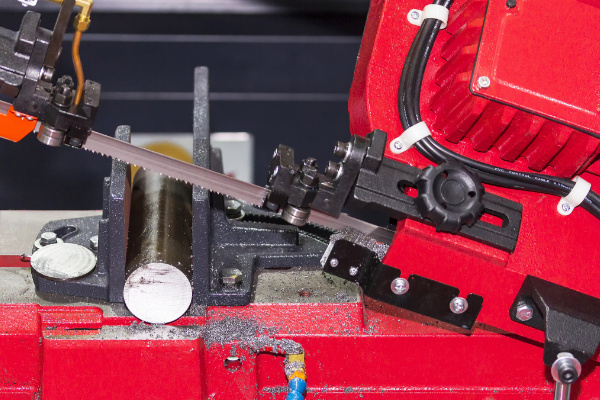
At LionNord Industry, our engineering focus on metal sawing solutions centers on the dual-column architecture. This configuration anchors the saw head on two massive, precision-ground pillars. Instead of acting as a cantilevered lever, the cutting head descends in a perfectly parallel motion. This eliminates the radial stress placed on the blade and dampens the acoustic and mechanical vibrations generated when the teeth bite into hardened alloys.
Pros and Cons: Dual-Column vs. Pivot-Style Saws
Dual-Column Structure
Pros: Exceptional rigidity; uniform feed rate across the entire material width; drastically reduces vibration decibels; ideal as an automatic band saw machine for large-diameter billets.
Cons: Higher initial capital investment; requires a larger floor footprint.
Pivot-Style (Scissor) Structure
Pros: Smaller footprint; lower initial cost; adequate for intermittent, light-duty cuts.
Cons: Uneven blade pressure; significant vibration amplification at wider cutting angles; shorter blade lifespan.
Vibration and Acoustic Data Comparison
Vibration directly correlates with acoustic output (decibels) and operational costs. Below is a comparative baseline from standard shop floor testing cutting a 300mm 4140 steel solid bar.
Machine Type | Average Vibration Amplitude (mm/s) | Acoustic Output (dB) | Average Blade Life (Cuts per blade) | Cut Deviation (per 100mm) |
Standard Pivot-Style Saw | 4.2 | 88 - 92 dB | 120 | 0.15 mm |
LionNord Dual-Column Saw | 1.1 | 74 - 78 dB | 310 | < 0.05 mm |
Data reflects controlled environment metrics. Actual results vary by material and feed rate.
Application Case: Aerospace Alloy Processing
A tier-2 aerospace component manufacturer in the Midwest recently upgraded their cutting floor. They previously used an older circular saw machine alongside a pivot band saw, resulting in unacceptable noise levels (exceeding OSHA 85 dB limits without PPE) and severe blade deflection when cutting titanium and Inconel billets.
By integrating a LionNord dual-column metal cutting machine, the facility saw immediate improvements. The twin-pillar design distributed the cutting forces evenly, dropping the ambient cutting noise to a manageable 76 dB. More importantly, the rigid frame prevented the blade from wandering, saving the company an estimated 12% in raw material waste over six months.
Expert Opinion
"The geometry of a dual-column saw changes the entire stress profile of the cutting operation," notes the lead structural engineer at LionNord Industry. "When you remove the pivot point, you stop amplifying the microscopic impacts of the blade teeth. The kinetic energy goes directly into the base casting rather than vibrating through the saw bow. If you want to be known as the best metal cutting machine supplier, you have to build from the floor up, prioritizing mass and parallel rigidity."
Q: Does the dual-column design impact other cutting equipment in the plant?
A: Yes, a stable base reduces transmitted floor vibrations, protecting the calibration of nearby CNC equipment and even your high precision aluminum cutting machine.
Q: What is the best saw blade for steel bar cutting on a dual-column machine?
A: For solid steel bars, a bi-metal M42 or M51 blade with variable tooth pitch (such as 2/3 or 3/4 TPI) is standard. The dual-column rigidity allows these blades to run at higher feed rates without premature tooth stripping.
Q: Can this machine be integrated into an automatic pipe cutting line?
A: Absolutely. Dual-column saws are frequently paired with automated material feeders and outfeed sorting systems for high-volume pipe and tube processing plants.
Q: How to cut stainless steel tube without deforming the walls?
A: Thin-walled stainless requires specific clamping. While a heavy-duty band saw can do the job with fine-tooth blades and variable vise pressure, a dedicated cold saw machine or specialized pipe cutting machine often provides the cleanest, burr-free finish for tubing under 100mm in diameter.
 English
 chinese
