
News
Band Saw Cutting Efficiency Coefficients: Titanium Alloys vs. Carbon Steel
03 Aug February 2026 | LionNord Industry
Analyzing Band Saw Cutting Efficiency: Titanium Alloys vs. Carbon Steel
In heavy-duty manufacturing, the material you cut dictates the equipment you run. The aerospace industry relies heavily on the strength-to-weight ratio of titanium, while automotive plants and standard steel service centers process massive volumes of carbon steel. Understanding the exact cutting efficiency coefficients between these metals is the only way to calculate true cost-per-cut.
At LionNord Industry, we engineer metal sawing solutions tailored to specific metallurgical demands. Below, we break down the shop-floor data comparing titanium alloys (like Ti-6Al-4V) against standard carbon steel (like 1045).
Baseline Data: Efficiency Coefficients and Machinability
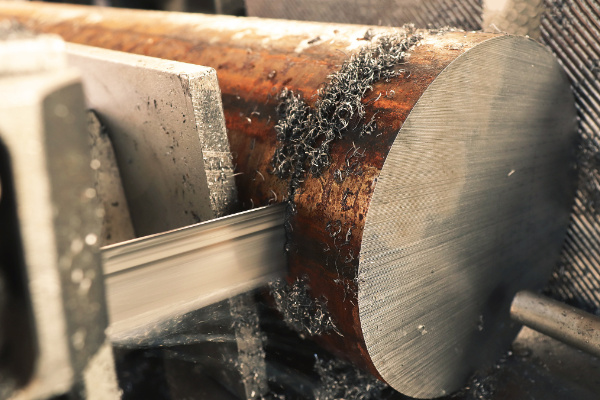
Cutting efficiency is essentially a machinability rating. If we assign 1045 carbon steel a baseline coefficient of 1.0 (or 100%), titanium alloys drop drastically to around 0.20 – 0.30. Titanium’s low thermal conductivity means heat transfers directly into the saw blade rather than the chip, leading to rapid tool degradation if the machine lacks rigidity.
Data Table: Cutting Parameters Comparison
| Parameter | 1045 Carbon Steel | Ti-6Al-4V Titanium Alloy |
| Efficiency Coefficient | 1.0 (Baseline) | 0.25 (25% of baseline) |
| Recommended Blade Speed | 80 - 100 m/min | 15 - 25 m/min |
| Coolant Requirement | Standard soluble oil (10%) | High-lubricity synthetic (15%+) |
| Feed Rate | Moderate to High | Low, constant pressure |
| Optimal Equipment | Standard metal band saw machine | Heavy-duty automatic band saw machine |
Pros and Cons Analysis on the Shop Floor
Machining Carbon Steel
Pros: Predictable chip formation; extended blade life; allows for high-speed throughput. A standard metal cutting machine handles this easily.
Cons: Low margin per cut. Profitability relies strictly on volume, requiring equipment with zero downtime.
Machining Titanium Alloys
Pros: High margin work; essential for aerospace and medical contracts.
Cons: Highly reactive metal. If the blade stops feeding while engaged, it will work-harden the material instantly, ruining the blade and potentially the workpiece. Requires absolute machine rigidity.
Real-World Application Cases
Case 1: Aerospace Component Production
An aerospace contractor was experiencing extreme blade deflection when cutting solid 200mm titanium billets. By upgrading to a LionNord dual-column automatic band saw machine, they stabilized the descent rate. The added dampening reduced harmonic vibration, increasing their carbide blade life by 40%.
Case 2: Steel Service Center and Tube Processing Plant
A high-volume steel supplier needed to process mixed batches of carbon steel and structural pipes. We installed a fully automated system featuring an automatic pipe cutting line alongside a heavy-duty steel bar cutting machine. By separating hollows from solids, their total daily output increased by 2,200 cuts. (For their non-ferrous division, a separate high precision aluminum cutting machine was integrated to prevent cross-contamination of chips).
Expert Opinion
"When cutting aerospace-grade titanium, vibration is your primary failure point. You cannot fix a rigidity problem with a better blade. If you want to cut titanium profitably, the frame and guides of your saw must weigh enough to absorb the harmonics. This is why partnering with an experienced industrial band saw machine supplier matters more than just comparing spec sheets."
— Lead Application Engineer, LionNord Industry.
Q: What is the best saw blade for steel bar cutting?
For solid carbon steel bars, a high-speed steel (HSS) bi-metal blade (M42 or M51) offers the best cost-to-performance ratio. For alloys and tool steels, carbide-tipped blades are recommended.
Q: How to cut stainless steel tube without burning the material?
Stainless steel work-hardens rapidly. You need a pipe cutting machine or cold saw machine set to a low RPM but a high, aggressive feed rate. Never let the blade rub without cutting. Flood the cutting zone with high-quality coolant.
Q: Do you need a different machine for non-ferrous metals?
Yes. While a standard band saw can cut aluminum, an aluminum cutting machine (often a high-speed circular saw) operates at significantly higher RPMs (up to 3,000+ RPM) to eject sticky chips efficiently.
Q: Why choose LionNord as your equipment partner?
Whether you need an entry-level manual saw or you are looking for the best metal cutting machine supplier to install a massive circular saw machine, LionNord Industry builds equipment engineered for specific materials. As a leading automatic circular saw manufacturer, we guarantee cutting tolerances and blade life metrics before installation.
 English
 chinese
