
News
How Automatic Material Indexing Accuracy of ±0.1mm Reduces Raw Material Waste
10 Aug February 2026 | Lionnord Industry
Automatic material indexing accuracy of ±0.1mm reduces raw material waste by eliminating the need for over-allowance programming. When equipment consistently hits a ±0.1mm feeding tolerance, operators no longer add extra stock length to compensate for mechanical positioning errors. Over high-volume production runs, this precise control prevents cumulative pitch error, reduces tail-end scrap, and directly increases the total yield of usable parts per raw stock unit.
The Mechanics of Material Indexing and Waste Reduction
Material indexing is the automated process of advancing raw stock into the cutting zone. Standard hydraulic feeding systems generally operate with tolerances ranging from ±0.5mm to ±1.0mm. To ensure secondary machining operations have enough material and to prevent undersized rejected parts, operators routinely program an additional safety margin of 1.0mm to 2.0mm per cut.
Upgrading to a servo-driven, high-precision indexing system with a ±0.1mm tolerance removes this requirement.
The Quantitative Impact:If an operator cuts 10,000 solid steel billets and reduces the safety margin from 1.0mm to 0.1mm, the facility saves 9 millimeters of material per 10 cuts. Across the entire 10,000-part run, the facility recovers 9 meters of solid raw material. When processing expensive materials like aerospace-grade aluminum, titanium, or high-carbon steel, the reduction in kerf and margin waste yields immediate financial returns.
Precision Cutting Machinery at Lionnord Industry
Achieving ±0.1mm indexing accuracy requires rigid machine construction and advanced CNC control. Lionnord Industry integrates this precision feeding technology across our primary industrial equipment:
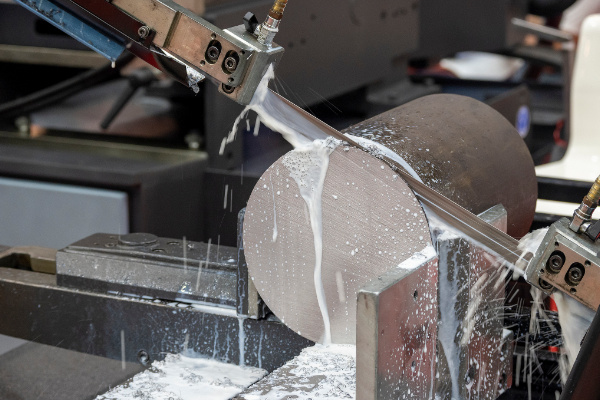
Metal band saw: Built for heavy-duty processing of solid bars, structural steel, and bundles. The high-precision automatic feed prevents progressive length deviation during long batch runs, ensuring the final cut in a bundle has the exact dimensions as the first, minimizing rejected scrap.
Metal circular cutting machine: Engineered for high-speed, high-volume repetitive cutting. The rapid cycling requires exact material positioning in fractions of a second. The ±0.1mm servo-feed prevents material slippage during clamping, maximizing the yield of high-grade steel bars.
Aluminum plate cutting machine: Processing large, expensive non-ferrous blocks requires exact dimensional control across long feed strokes. Accurate indexing ensures the initial squaring cuts require minimal trim, yielding maximum usable surface area from the raw plate.
Client Case Studies: Measuring the Savings
Case Study 1: Automotive Forging Supplier
Challenge: A high-volume automotive parts manufacturer was losing 6% of their solid steel bar stock to excessive trim allowances and cumulative feeding errors on aging hydraulic equipment.
Solution: Installed a Lionnord Industry metal circular cutting machine featuring CNC servo-indexing with ±0.1mm accuracy.
Result: The facility eliminated the 1.5mm safety margin per cut. Raw material waste dropped by 4.2%, translating to a material cost savings of $85,000 annually.
Case Study 2: Aerospace Component Fabricator
Challenge: Cutting thick 7075 aluminum blocks resulted in high scrap rates because manual indexing could not hold tolerances better than ±1.0mm over a 2-meter feed.
Solution: Integrated a Lionnord Industry aluminum plate cutting machine with automated precision indexing.
Result: Achieved exact cut-to-length dimensions, allowing the facility to order raw plates 3% smaller than previously required, significantly reducing initial procurement costs.
What causes standard material indexing systems to lose accuracy?
Standard systems rely on limit switches and basic hydraulic cylinders, which are susceptible to fluid temperature changes, mechanical wear, and material slippage. This results in positioning variances up to 1.0mm.
How does ±0.1mm accuracy prevent cumulative pitch error?
Cumulative pitch error occurs when a small feeding inaccuracy multiplies over multiple advances (e.g., feeding a 500mm length three times to achieve a 1500mm cut). A ±0.1mm servo-driven system uses absolute encoders to track the exact position continuously, preventing the error from stacking.
Does higher indexing accuracy slow down the cutting cycle?
No. Modern servo-driven ball screw mechanisms accelerate and decelerate faster than standard hydraulic pushers. This allows the machine to achieve ±0.1mm positioning rapidly, maintaining or even increasing overall throughput.
 English
 chinese
