
News
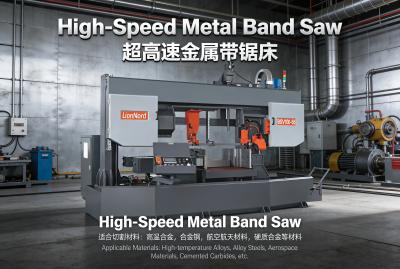
What is a high-speed metal band saw? What are the special features of LAIANNUO that make it so effic
27 Mar February 2026 | LionNord
What is a high-speed metal band saw? What are the special features that make it so efficient?
Zhejiagn LAIANNUO Industry and trade Co., Ltd. ultra high speed metal band saw is a high-end CNC equipment that cuts metal materials with a saw blade line speed of 300-600 meters/minute (traditional equipment only 80-150 meters/minute). It integrates mechanical, electronic, hydraulic, and intelligent control technologies and is designed for efficient and precise cutting of various metal materials. It is widely used in fields such as automotive manufacturing, aerospace, and precision machinery. It achieves a perfect fusion of "ultra fast cutting" and "micrometer level precision" through disruptive technology, with efficiency increased by more than 2-3 times compared to traditional band sawing machines.
1、 Core definition of ultra high speed metal band sawing machine
The ultra high speed metal band saw is essentially a continuous cutting equipment for circular band saws, and its core features are:
The linear speed of the saw blade has exceeded the traditional limit, reaching 300-600 meters per minute
Adopting permanent magnet synchronous servo drive and precision transmission system to achieve real-time closed-loop control of speed
Integrated intelligent adaptive control system, capable of dynamically adjusting cutting parameters
Equipped with specially designed ultra high speed saw blades to ensure high-speed cutting stability
Applying high-precision positioning and error compensation technology to ensure machining accuracy at extremely high speeds
2、 Five special characteristics achieve ultimate efficiency
1. Revolutionary driving system: the core driving force for efficiency breakthroughs
Technological innovation improves the efficiency of ultra high speed band sawing machines
Drive motor permanent magnet synchronous servo motor, instantaneous power can reach 30kW, torque stability increased by 50%
Control precision 16 bit encoder, speed accuracy ± 1 rpm, cutting stability improved by 80%
Transmission mechanism precision gearbox+dual wheel synchronous drive, transmission efficiency 95%+energy loss reduced by 40%
Speed range of 300-600 meters/minute, cutting speed increased by 2-4 times
Key advantage: When cutting 45 steel, the traditional equipment takes 12 seconds to complete the 50mm diameter cutting operation, while the ultra high speed saw only takes 3.5 seconds to complete, and the cutting flatness reaches Ra1.6 μ m.
2. Ultra high speed cutting tool technology: reliable guarantee for high-speed cutting
Material breakthrough: Ultra fine grain hard alloy, with a hardness of HRC65 after vacuum heat treatment, and a 0.1mm wear-resistant layer formed by laser strengthening of the cutting edge
Structural optimization: Variable tooth pitch design (tooth pitch error ≤ 0.02mm), effectively dispersing cutting stress and avoiding vibration resonance
Extended lifespan: When cutting stainless steel 304, the service life is extended from 1-2 hours to over 8 hours, and the downtime for tool change is reduced by 80%
Cut quality: The roughness of the cutting surface reaches Ra0.8 μ m, eliminating the need for subsequent polishing processes and reducing single piece processing time by 40%
3. Intelligent adaptive control system: high-speed and stable "brain"
Real time parameter collection: Industrial grade PLC synchronously monitors 12 cutting parameters (current, pressure, temperature, etc.)
Dynamic adjustment mechanism: responds to material hardness changes within 0.05 seconds, automatically adjusts feed rate by 10% -20%, and avoids saw blade breakage
Multi speed control: low-speed cutting (10 meters/minute) when in contact with the workpiece → stable cutting at high speed → medium speed before cutting (20 meters/minute) to prevent material cracking
Intelligent lubrication system: Oil air lubrication (0.1ml/precise supply), cooling efficiency is three times higher than traditional spraying, and saw blade life is extended by three times
4. High precision structural design: balance between speed and precision
Dynamic error compensation: Real time detection of grating ruler (resolution 0.5 μ m), combined with servo system for micrometer level correction
Ultra stable support: The saw blade shaft adopts air static pressure bearings, and the radial runout is controlled within 3 μ m
Vibration suppression: The shock-absorbing pad iron at the bottom of the fuselage absorbs more than 90% of high-frequency vibrations, with a verticality error of ≤ 0.02mm/100mm
Accuracy performance: The length tolerance is stable at ± 0.03mm, and the cutting roughness reaches Ra0.8 μ m, meeting the requirements for direct machining of precision parts
5. Full process automation: eliminating non cutting time waste
Dual station design: Loading and cutting are carried out synchronously, reducing the material change time to 2 seconds
Automatic feeding system: With CNC control, continuous batch processing is achieved, and a single shift can process 500+small diameter steel bars (traditional only 150-200 pieces)
Intelligent chip removal device: negative pressure adsorption+spiral conveying, real-time chip cleaning, avoiding accumulation and affecting efficiency
Unmanned operation: The entire process from workpiece loading to unloading is automatically completed, reducing manual intervention and lowering labor costs by 60%
3、 Quantitative results of comprehensive efficiency improvement
Leap in production capacity: The rough machining capacity of the transmission shaft in the automotive parts factory has increased by 220%, and the single shift output has jumped from 800 pieces to 2500 pieces
Cost reduction: Tool wear costs are reduced by 60%, material utilization rate is increased from 75% to 92%, and steel costs are saved by over 800000 yuan annually
Time reduction: The subsequent grinding allowance of the gear blank is reduced from 0.3mm to 0.1mm, and the processing time for a single piece is shortened by 40%
Decreased failure rate: The failure rate of traditional equipment decreases from 15% to below 2% during high-speed operation, ensuring continuous production stability
summary
The ultra high speed metal band sawing machine has broken the paradox of traditional cutting equipment's inability to achieve both speed and accuracy through revolutionary innovation in five dimensions: drive system, tool technology, intelligent control, structural design, and automation level. It has achieved a composite advantage of 2-3 times higher cutting efficiency, micrometer level processing accuracy, and 40% lower comprehensive cost, becoming the core equipment for improving quality and efficiency in modern metal processing.
LAIANUO The core advantages of ultra high speed metal band sawing machines are fast cutting speed, high precision, good cutting quality, and suitability for continuous large-scale cutting. They are mainly used in high-end manufacturing and large-scale processing fields that require high production efficiency, material utilization, and cutting precision. Typical applications are as follows:
1. Automotive manufacturing and parts industry (most mainstream application)
Cutting of raw materials such as drive shaft, half shaft, connecting rod, gear blank, wheel hub blank, bearing ring, shock absorber steel pipe, etc
High speed cutting of various rods/pipes for engines, chassis, and braking systems
Features: Large quantity, high tempo, requirement for smooth cutting, reducing subsequent car/grinding allowance
2. Aerospace industry
Cutting of difficult to machine materials such as titanium alloys, high-temperature alloys, high-strength stainless steel, and aviation aluminum alloys
Precision cutting of wing, fuselage structural components, and engine parts blanks
Characteristics: Expensive materials, requiring low loss, high precision, no burrs, and minimal deformation
3. Construction Machinery and Heavy Machinery
Round steel, square steel, thick walled steel pipes for excavators, loaders, cranes, hydraulic cylinders, etc
Cutting of large shaft, flange, and structural component blanks
Characteristics: The workpiece has a large cross-section and high material hardness, requiring high cutting efficiency and stability
4. Rail transit (high-speed rail, subway, urban rail)
Bogie, carriage aluminum profiles, rail fittings, fasteners, body structural components
High precision cutting of high-strength steel and lightweight alloys
Features: High assembly accuracy requirements, no breakage or deformation allowed
5. New energy equipment
Wind power: cutting of large alloy steel components such as main shafts, wheel hubs, and tower connections
Photovoltaic/energy storage: bracket aluminum profiles, battery pack structural components, copper aluminum busbar cutting
Features: Large production capacity demand, suitable for continuous operation on automated production lines
6. Precision Machinery and Mold Manufacturing
Mold steel, high-speed steel, alloy tool steel, precision shaft blanks
Require straight and high verticality of the incision to directly reduce the amount of grinding and milling processing
7. Processing of metal pipes/profiles
Large scale cutting of seamless steel pipes, stainless steel pipes, copper pipes, aluminum profiles, and special-shaped materials
Batch cutting of plumbing, air conditioning, hydraulic pipelines, building profiles, etc
8. Ship and Ocean Engineering
High strength steel plates, profiles, offshore platform structural components, anchor chain/shaft blanks for ships
Efficient cutting of thick walled and large cross-section materials
9. Standard parts/hardware fasteners
High speed continuous cutting of small-sized bar materials such as bolts, nuts, pins, rivets, etc
Pursuing extremely high single machine production capacity, suitable for multi station cold heading and pre turning material preparation
10. Preparation of materials before casting/forging
Precision cutting and cutting of casting and forging blanks, controlling the accuracy of cutting length
Improve material utilization and reduce subsequent machining allowances
 English
 chinese
